


REPTOR-250 Project: Raspberry Pi Advanced Status Monitor
At 4D Systems, we empower engineers and developers with innovative solutions like the REPTOR-250 display module. In our latest project, the Raspberry Pi Advanced Status Monitor, you'll see how this...

The gen4-RP2350 Series features 2.4”–9” touch displays with dual-core RP2350, secure Arm TrustZone, and Workshop5 IDE support for embedded and IoT projects.

Unveiling the Enhanced microOLED PIXXI Series
Introducing the uOLED-96P2, uOLED-128P2, and uOLED-160P2—now with the PIXXI-28 processor. These upgraded microOLEDs offer vivid colors, faster performance, and easy GUI design with ViSi-Genie support.

Announcing LVGL Certification for 4D Systems gen4-ESP32 Display Series
The 4D Systems gen4-ESP32 series is LVGL certified, featuring the ESP32-S3R8 processor, up to 800x480 resolution, and touch options for powerful, easy GUI development.

Strengthening Our Partnership: 4D Systems and Breadboard Mates Merge Production and Resources
4D Systems and Breadboard Mates have merged to expand product reach, enhance support, and drive innovation.

uLCD-480RD: A Breakthrough in Visual Display Solutions
The uLCD-480RD is a 2.1″ round intelligent display powered by the DIABLO-16 processor, offering 480-pixel diameter resolution. Available in touch and non-touch models, it’s easily programmed with t...

The gen4-ESP32 Range: Elevating Display Technology
The gen4-ESP32 range delivers powerful, versatile displays for IoT, offering easy integration and development with the Workshop4 IDE.
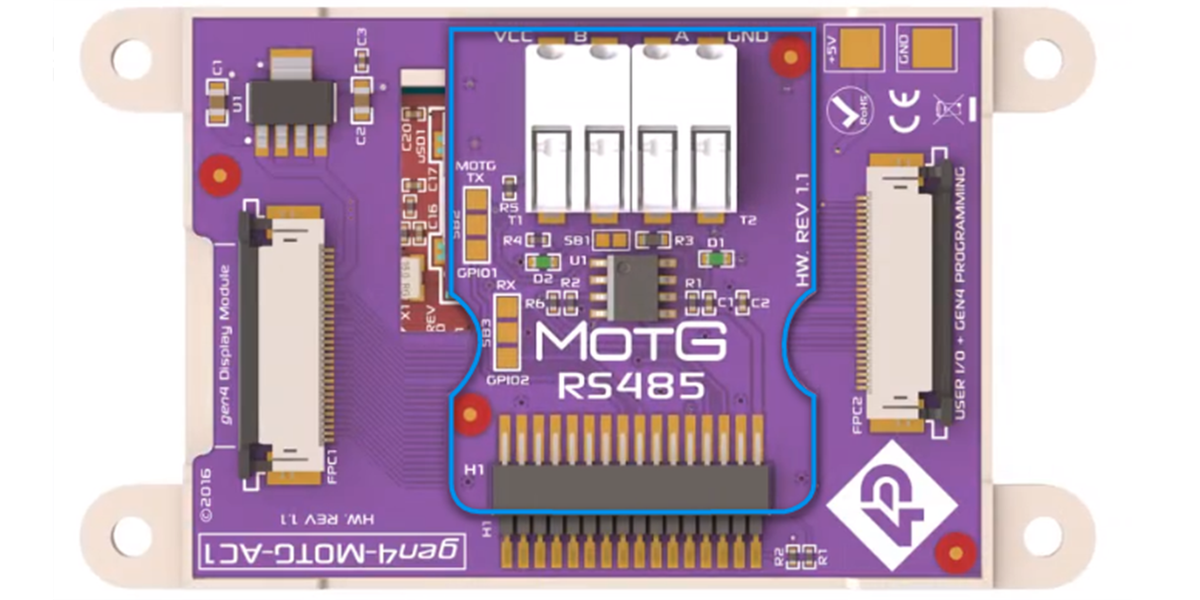
No RS485 in your display processor? Here’s a solution
This article elucidates the imperative of RS485 communication in industrial settings, especially in long-distance data transmission amongst varied devices. It delineates how 4D Systems’ MOTG-RS485 ...
![[Webinar Recording] Advancing Critical Care with Intelligent Displays](http://4dsystems.com.au/cdn/shop/articles/MicrosoftTeams-image-blog-banner_0539a0c6-cee3-4996-a8c2-709259846456.png?v=1773707575&width=2400)
[Webinar Recording] Advancing Critical Care with Intelligent Displays
This blog offers a recap of a recent webinar session detailing the introduction of the Amarysia Artemis, a 3D-printed medical mask designed for ICU scenarios. Equipped with integrated bio-sensor an...
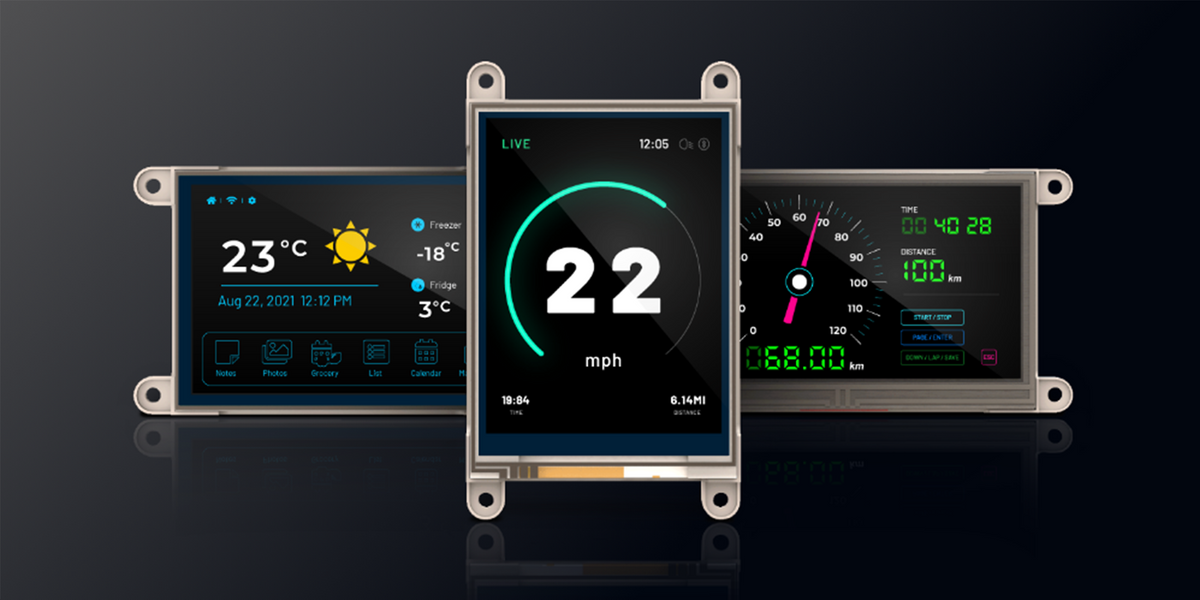
Careful there! Your guide to touch screen care.
This guide delves into comprehensive methods for maintaining touch screens, an integral component in modern electronics, to ensure their optimum accuracy, performance, and longevity. It encompasses...

Faster, Smarter, Stronger: Uncovering the gen4 intelligent displays
The gen4 series of intelligent display modules by 4D Systems facilitates seamless interaction between users and technology across various industries. With diverse size options and touch capabilitie...

Announcing the uLCD-104D Series
The uLCD-104D Diablo16 is a 10.4" integrated display module offering horizontal extended info, powered by the Diablo16 graphics processor. It features optional capacitive touch, 1024×100 resolution...
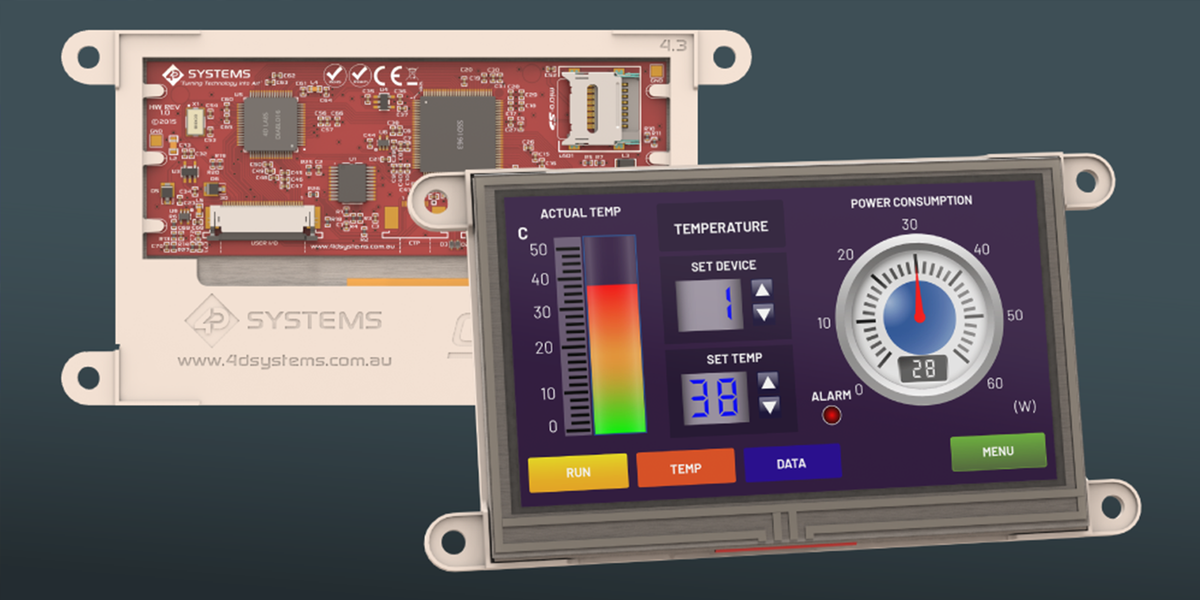
Announcing the GEN4-uLCD-43-HR Series
The gen4-uLCD43-HS is a 4.3" intelligent display with 800×480 resolution, resistive or capacitive touch, and powered by the Diablo16 graphics processor. It features 16 customizable GPIO, built-in a...

4 Steps for Embedded UI Design
The concept of "Creating Intuitive Interfaces for Embedded Systems" highlights the importance of User Interface (UI) and User Experience (UX) in embedded systems, allowing users to effectively inte...

Unveiling the gen4 Series Displays featuring Wide Viewing Angles
The gen4 display series now offers Wide Viewing Angle (WVA) models, combining cost-effective TN technology with near-IPS viewing angles. Powered by the Diablo16 graphics processor, these displays c...
Innovative Display Solutions


Frequently Asked Questions
Find quick answers about our display modules, embedded integration, customization capabilities, and system compatibility.

How do I choose the right display module for my project?
Start by identifying the demands of your product environment: required screen size, touch capability, operating conditions and UI complexity. Our consistent form-factor families allow you to select a module that fits your constraints today and upgrade performance later without redesigning your enclosure or PCB. Our documentation hub provides comparison tables to assist selection.
What is the difference between a smart display and a host-driven display?
Smart displays include an onboard processor that handles graphics, widgets, UI logic and drawing commands internally. This reduces load on your host MCU, simplifies code and often shortens development time dramatically. Host-driven modules require the host MCU to manage everything, which may be appropriate for minimal UIs but introduces more integration work.
Can I upgrade processors without changing my enclosure or PCB?
Yes. Our architecture is deliberately designed around footprint consistency. Most display families maintain identical mechanical and electrical footprints across multiple processor types, enabling generation-to-generation performance improvements without mechanical redesign.
Do you offer non-touch and touch options?
Yes. Many display families provide variants for non-touch, resistive-touch and capacitive-touch configurations. Capacitive-touch variants are recommended for modern, responsive UI experiences.
INDUSTRIES WE SERVE
Across all industries, engineers want clarity, stability, and intelligent embedded design.
We design solutions that align with how engineering teams work. Our approach reduces redesigns, supports multiple processors with the same form factor, and integrates cleanly with existing hardware.


