


20+ Years of Experience
Embedded display engineering, end to end
Full Lifecycle Support
Products supported across full lifecycles
Field-Proven
Global deployments in demanding environments
Production-ready
Low-risk interfaces built to work the first time
uVGA-III
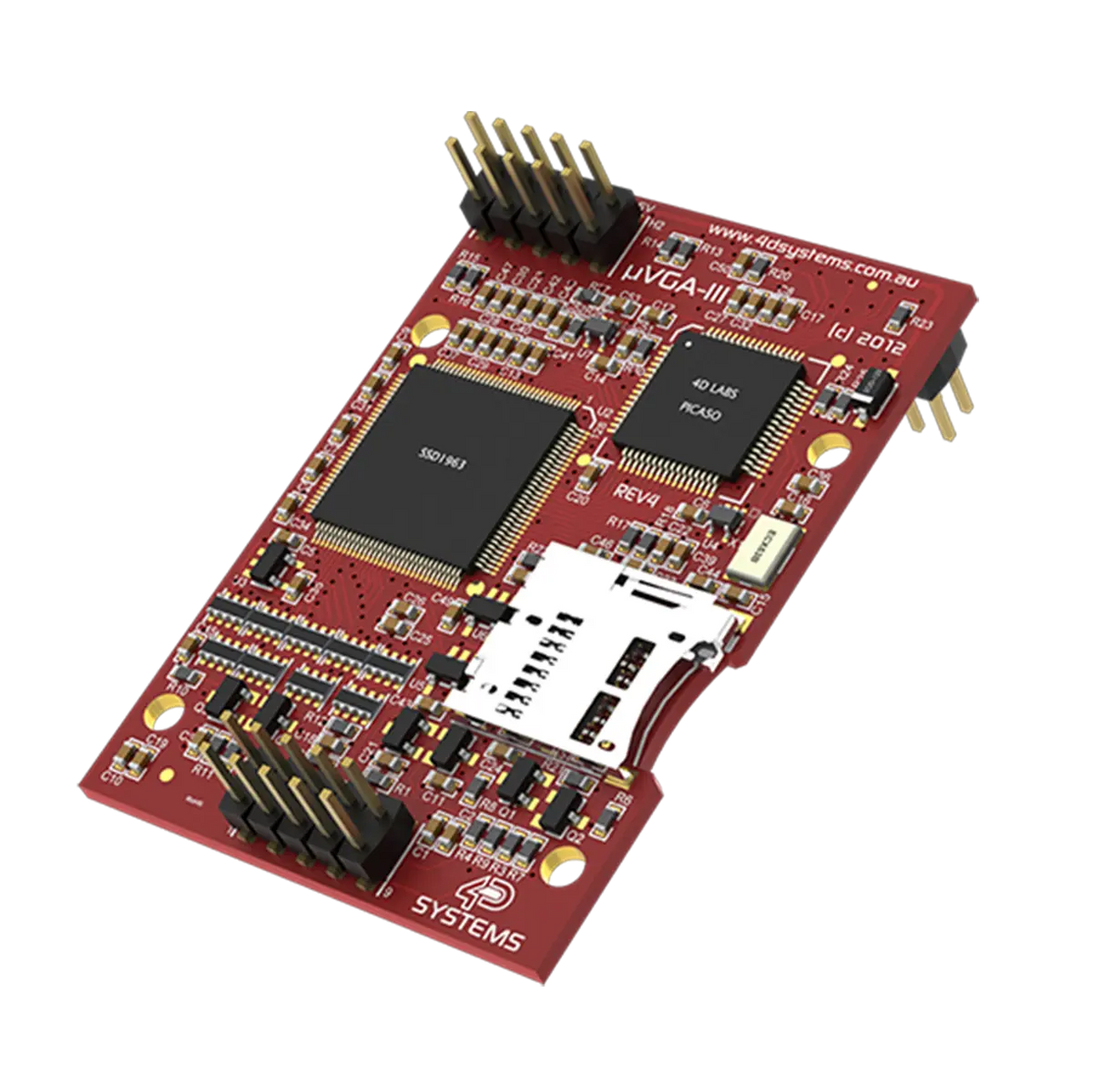
The uVGA-III is a compact VGA graphics engine powered by the PICASO processor, supporting resolutions up to 800x480. It features a microSD card slot for multimedia storage, 13 GPIO pins, and interfaces including I²C and UART. Ideal for applications requiring rich graphics and audio output.
Volume Discount
The VGA interface for any application
The uVGA-III is a compact and cost-effective VGA Graphics Engine packed with features. It is ready to become the GUI for your target application and can also serve as an interface controller for several other applications.
The PICASO processor is embedded at the heart of the design, driven by a highly optimised virtual core engine called EVE (Extensible Virtual Engine). The design integrates an extensive range of hardware and software peripherals, allowing users to adapt the module to suit almost any application.
The module combines a display driver capable of 320×240 (QVGA), 640×480 (VGA), and 800×480 (WVGA) resolution output to a standard VGA display, a micro-SD card connector, along with a group of general-purpose input/output pins (GPIOs), including I2C and serial UART communications.
This module is a perfect solution for connecting to an external VGA monitor for an application requiring animation, slideshows, images, or sound. This PICASO-driven Intelligent Display Module perfectly exemplifies where art meets technology.
Audio support on the display module is supplied by the PICASO processor, which outputs a line-level audio signal ready to drive an external amplifier of choice. Simple instructions enable the user to play audio files while continuing the execution of the user application code, such as display updates, communications, and much more.
The micro-SD card slot provides the user with expandable memory space for retrieving multimedia files, including images, animations, movie clips, and data-logging applications.
The module can be programmed as a master or slave device using the Workshop 4 IDE Software. It can also be configured as a serial slave with your favourite Host Controller. With the intelligent uVGA-III VGA Graphics Engine module, freedom is at your fingertips.


Product Availability Statement


Features
- Supports the following resolutions: 320 x 240 (QVGA), 640 x 480 (VGA), 800 x 480 (WVGA)
- It supports RGB 65K true-to-life colours.
- Easy 5-pin interface to any host device: VCC, TX, RX, GND, RESET
- Powered by the 4D-Labs PICASO processor
- 14KB of flash memory for user code storage and 14KB of SRAM for user variables, or 14KB shared user code and program variables.
- 2 x Asynchronous hardware serial UART ports (COM0, COM1), TTL interface, with 300 to 600K baud
- 1 x I2C interface (Master).
- 8 x 16-bit timers with 1-millisecond resolution.
- 13 x General Purpose I/O pins. It supports fast 8-bit parallel data transfer through the upper 8 bits.
- On-board micro-SD memory card adaptor for multimedia storage and data logging purposes.
- DOS-compatible file access (FAT16 format) and low-level access to card memory.
- Dedicated Line-Level PWM Audio pin driven by WAV files from a micro-SD card.
- Built-in extensive 4DGL graphics and system library functions.
- Display full-colour images, animations, icons and video clips.
- Supports all available Windows fonts.
- A 30-pin header for I/O expansion (supplied but not soldered onto the PCB)
- 15-pin D-type standard VGA connector to interface to any external VGA monitor on a remote and detachable cable.
- 4.0V to 5.5V range operation (single supply).
- Module dimensions: 39.0 x 63.0 x 21.5mm
- Weight ~ 17g.
- RoHS Compliant.
What’s in the box
- uVGA-III Module
- 150mm 5-way Female-Female jumper cable
- 5-way Male-Male adaptor
- 30-way Male SMT pin header
- 15-pin standard VGA connector on 10-way ribbon cable
- Getting Started Manual.
Suppose you are a first-time user and just beginning your development. In that case, we strongly recommend purchasing a Starter Kit of this same model, as it includes additional items that allow you to start your development immediately.
Frequently Asked Questions
Find quick answers about our display modules, embedded integration, customization capabilities, and system compatibility.

How do I choose the right display module for my project?
Start by identifying the demands of your product environment: required screen size, touch capability, operating conditions and UI complexity. Our consistent form-factor families allow you to select a module that fits your constraints today and upgrade performance later without redesigning your enclosure or PCB. Our documentation hub provides comparison tables to assist selection.
What is the difference between a smart display and a host-driven display?
Smart displays include an onboard processor that handles graphics, widgets, UI logic and drawing commands internally. This reduces load on your host MCU, simplifies code and often shortens development time dramatically. Host-driven modules require the host MCU to manage everything, which may be appropriate for minimal UIs but introduces more integration work.
Can I upgrade processors without changing my enclosure or PCB?
Yes. Our architecture is deliberately designed around footprint consistency. Most display families maintain identical mechanical and electrical footprints across multiple processor types, enabling generation-to-generation performance improvements without mechanical redesign.
Do you offer non-touch and touch options?
Yes. Many display families provide variants for non-touch, resistive-touch and capacitive-touch configurations. Capacitive-touch variants are recommended for modern, responsive UI experiences.