


20+ Years
Embedded display engineering, end to end
Full Lifecycle Support
Products supported across full lifecycles
Field-Proven
Global deployments in demanding environments
Production-ready
Low-risk interfaces built to work the first time
Display Size
2.4 / 60.96 mm
Resolution
320 × 240 pixels
Colours
RGB 65K
Viewing Area
49.0 × 36.7 mm
4DPI-24-HAT
- Please note that this product is not available directly from 4D Systems. You can purchase directly from Farnell HERE.
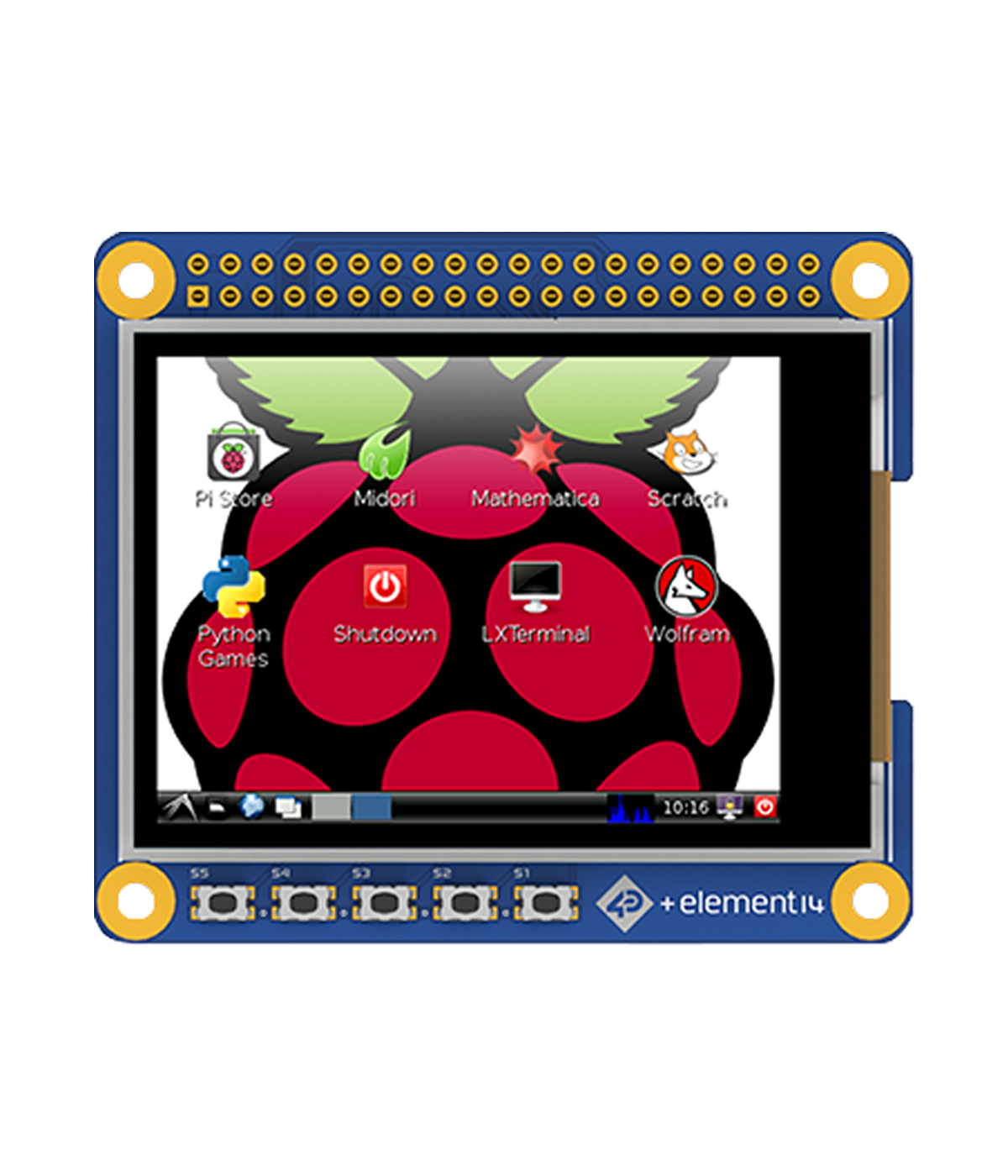
- 2.4" 320x240 pixels HAT Primary Display for the Raspberry PI.
- Plugs directly on top of the Raspberry Pi, compatible with A+, B+, Pi2, Pi3, Pi3 B+, Pi Zero, Pi Zero W and Pi4 Models.
- High speed SPI Interface with Compression Technology enables high speed graphics.
- See product description below for more details.
Volume Discount
2.4″ Primary Display HAT for the Raspberry Pi
Please note that this product is NOT available directly from 4D Systems. You can purchase directly from Farnell Here.
The 4DPi-24-HAT is a 2.4″ 320×240 Primary Display HAT for the Raspberry Pi, which plugs directly on top of a Raspberry Pi and displays the primary output which is normally sent to the HDMI or Composite output. It features an integrated Resistive Touch panel, enabling the 4DPi-24-HAT to function with the Raspberry Pi without the need for a mouse.
Communication between the 4DPi-24-HAT and the Raspberry Pi is interfaced with a high speed 48Mhz SPI connection, which utilises an on-board processor for direct command interpretation and SPI communication compression, and features a customised DMA enabled kernel.
The 4DPi-24-HAT is designed to work with the Raspbian Operating System running on the Raspberry Pi, as that is the official Raspberry Pi operating system. It is also compatible with the new PIXEL addition to Raspbian.
The 4DPi-24-HAT is powered directly off the Raspberry Pi’s 40 way Header, and the 2.4″ Touch Screen allows effortless interaction with the Raspbian Operating System.

Product Availability Statement


Information about the display module
- Universal 2.4″ Primary Display for the Raspberry Pi
- Compatible with Raspberry Pi A+, B+, Pi2, Pi3, Pi3 B+, Pi Zero, Pi Zero W and Pi4
- 320×240 QVGA Resolution, RGB 65K true-to-life colours, TFT Screen with integrated 4-wire resistive touch panel
- Displays full GUI output / primary output, just like a monitor
- High-speed 48Mhz SPI connection with compression technology
- Powered directly off the Raspberry Pi — no external power needed
- Typical frame rate of 25FPS (higher if kernel compression applies)
- On/Off or PWM controlled backlight (selectable via jumper)
- Onboard identification EEPROM
- Module dimensions: 56.5 × 65.0 × 14.2mm (~30g)
- Display viewing area: 49.0 × 36.7mm
- 4× mounting holes (2.7mm diameter)
- RoHS and CE compliant
- HAT standard compliant
The 4DPi-24-HAT includes the following items:
- 4DPi-24-HAT module
- Getting Started Manual (downloadable)
Frequently Asked Questions
Find quick answers about our display modules, embedded integration, customization capabilities, and system compatibility.

How do I choose the right display module for my project?
Start by identifying the demands of your product environment: required screen size, touch capability, operating conditions and UI complexity. Our consistent form-factor families allow you to select a module that fits your constraints today and upgrade performance later without redesigning your enclosure or PCB. Our documentation hub provides comparison tables to assist selection.
What is the difference between a smart display and a host-driven display?
Smart displays include an onboard processor that handles graphics, widgets, UI logic and drawing commands internally. This reduces load on your host MCU, simplifies code and often shortens development time dramatically. Host-driven modules require the host MCU to manage everything, which may be appropriate for minimal UIs but introduces more integration work.
Can I upgrade processors without changing my enclosure or PCB?
Yes. Our architecture is deliberately designed around footprint consistency. Most display families maintain identical mechanical and electrical footprints across multiple processor types, enabling generation-to-generation performance improvements without mechanical redesign.
Do you offer non-touch and touch options?
Yes. Many display families provide variants for non-touch, resistive-touch and capacitive-touch configurations. Capacitive-touch variants are recommended for modern, responsive UI experiences.