


20+ Years of Experience
Embedded display engineering, end to end
Full Lifecycle Support
Products supported across full lifecycles
Field-Proven
Global deployments in demanding environments
Production-ready
Low-risk interfaces built to work the first time
GEN4-PA
Volume Discount
Available Models & Details
GEN4-PA
Overview and Purpose
Overview and Purpose
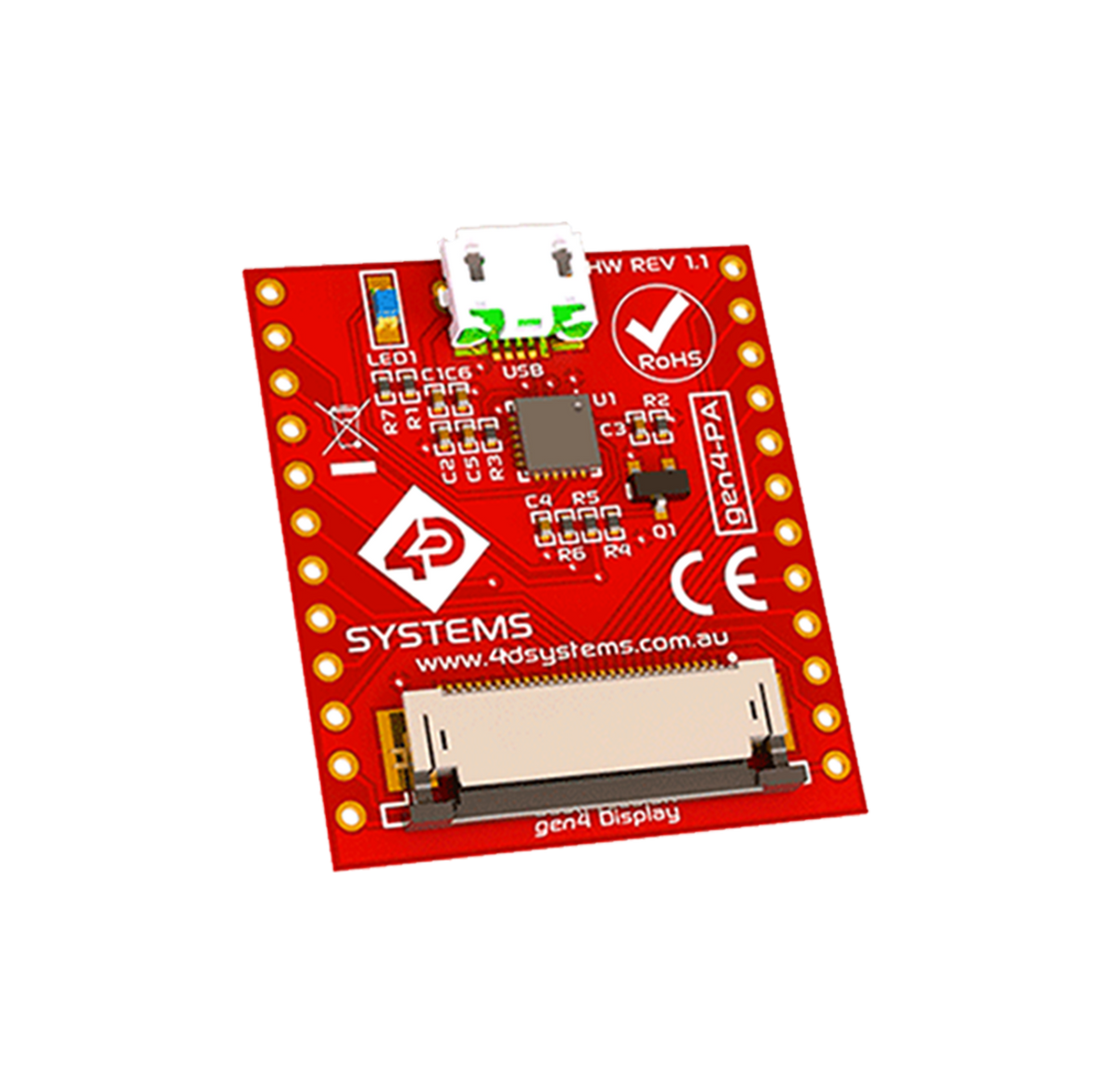
The gen4-PA (Gen4 Programming Adaptor) is compatible with all of the gen4 range of Intelligent Display modules, which feature PICASO or DIABLO16 graphics processors. It is included in the Starter Kit (SK) packs and is a quick and easy way to interface and program the gen4 range.
The gen4-PA is a programming adaptor for the gen4 display module that also breaks out the signals found on the 30-way FFC cable coming from your gen4 display module. These signals are available via 2.54mm pitch (0.1”) pads around the edge of the gen4-PA. It also groups the standard 5-way signals found on other 4D Systems products (and the gen4-IB) for easy interface with various products.

Features and Benefits
Features and Benefits
The gen4-PA replaces the need for a separate standard programmer, such as the uUSB-PA5 or 4D Programming Cable. The gen4-PA has the circuitry found on the uUSB-PA5-II built into it, and features a microUSB jack for connection to your PC. Cable is not included with the gen4-PA, this needs to be purchased separately.
The gen4-PA can be used for programming gen4 display modules, interfacing to a breadboard for prototyping, interfacing to Arduino and Raspberry Pi interfaces, or for interfacing with virtually any host.
Overview and Purpose
The gen4-PA (Gen4 Programming Adaptor) is compatible with all of the gen4 range of Intelligent Display modules, which feature PICASO or DIABLO16 graphics processors. It is included in the Starter Kit (SK) packs and is a quick and easy way to interface and program the gen4 range.
The gen4-PA is a programming adaptor for the gen4 display module that also breaks out the signals found on the 30-way FFC cable coming from your gen4 display module. These signals are available via 2.54mm pitch (0.1”) pads around the edge of the gen4-PA. It also groups the standard 5-way signals found on other 4D Systems products (and the gen4-IB) for easy interface with various products.
Features and Benefits
The gen4-PA replaces the need for a separate standard programmer, such as the uUSB-PA5 or 4D Programming Cable. The gen4-PA has the circuitry found on the uUSB-PA5-II built into it, and features a microUSB jack for connection to your PC. Cable is not included with the gen4-PA, this needs to be purchased separately.
The gen4-PA can be used for programming gen4 display modules, interfacing to a breadboard for prototyping, interfacing to Arduino and Raspberry Pi interfaces, or for interfacing with virtually any host.
Product Availability Statement


Frequently Asked Questions
Find quick answers about our display modules, embedded integration, customization capabilities, and system compatibility.

How do I choose the right display module for my project?
Start by identifying the demands of your product environment: required screen size, touch capability, operating conditions and UI complexity. Our consistent form-factor families allow you to select a module that fits your constraints today and upgrade performance later without redesigning your enclosure or PCB. Our documentation hub provides comparison tables to assist selection.
What is the difference between a smart display and a host-driven display?
Smart displays include an onboard processor that handles graphics, widgets, UI logic and drawing commands internally. This reduces load on your host MCU, simplifies code and often shortens development time dramatically. Host-driven modules require the host MCU to manage everything, which may be appropriate for minimal UIs but introduces more integration work.
Can I upgrade processors without changing my enclosure or PCB?
Yes. Our architecture is deliberately designed around footprint consistency. Most display families maintain identical mechanical and electrical footprints across multiple processor types, enabling generation-to-generation performance improvements without mechanical redesign.
Do you offer non-touch and touch options?
Yes. Many display families provide variants for non-touch, resistive-touch and capacitive-touch configurations. Capacitive-touch variants are recommended for modern, responsive UI experiences.