


20+ Years of Experience
Embedded display engineering, end to end
Full Lifecycle Support
Products supported across full lifecycles
Field-Proven
Global deployments in demanding environments
Production-ready
Low-risk interfaces built to work the first time
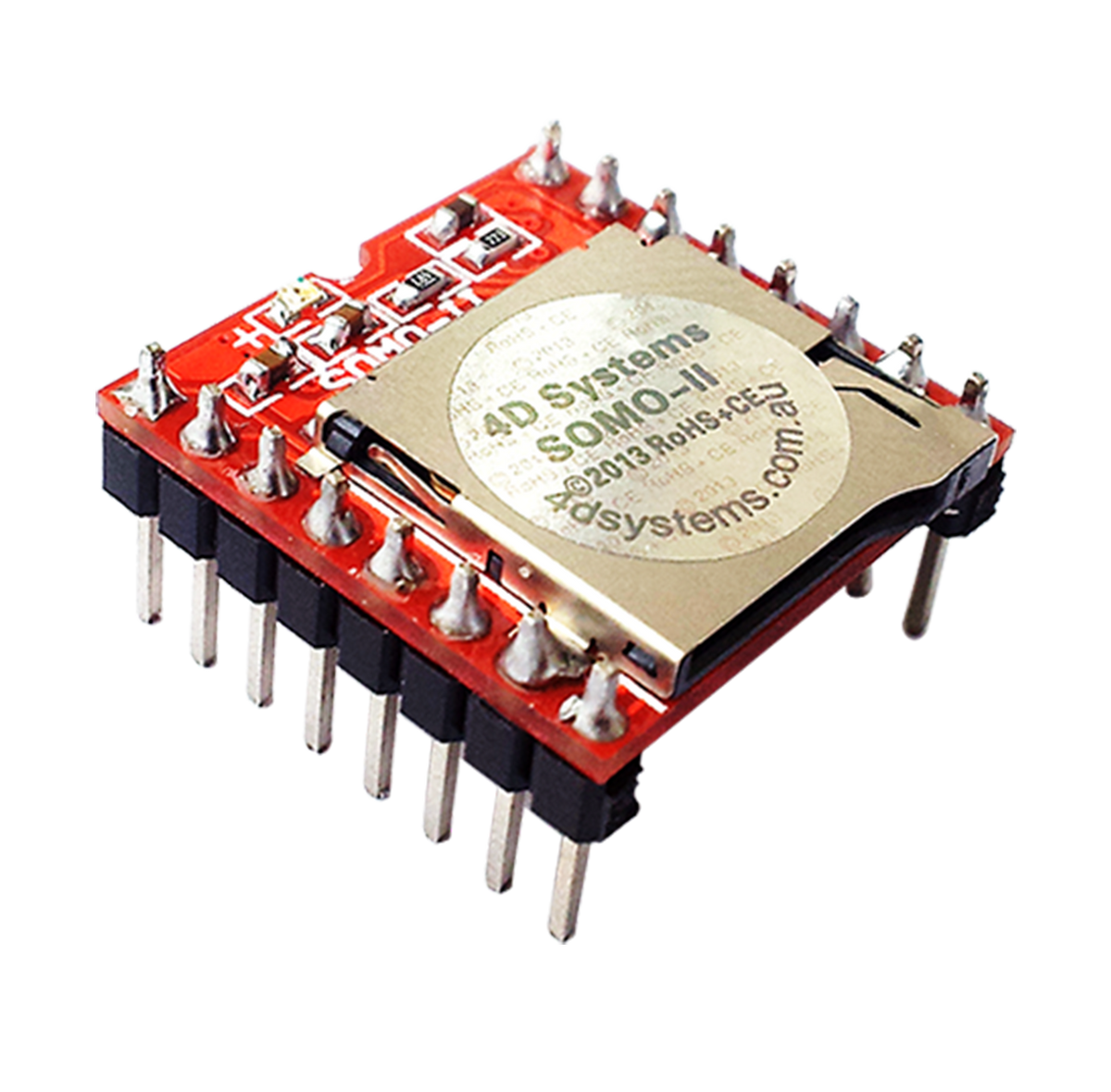
SOMO-II
- Tiny Audio-Sound module that can play MP3 audio files stored on a micro-SD card (or USB 2.0 Flash drive with extra components).
- Features an on-board 16bit MCU specifically designed for hardware audio decoding.
- Supports FAT16 and FAT32 formatted micro-SD and USB Flash Drives.
Volume Discount
SOMO-II
SOund MOdule 2 (SOMO-II) is a tiny Audio-Sound module that can play MP3 audio files stored on a micro-SD card (or USB 2.0 Flash drive with extra components), such as voice and music.
The SOMO-II features an on-board 16bit MCU, specifically designed for hardware audio decoding.
It supports both FAT16 and FAT32 formatted micro-SD and USB Flash Drives (up to 32Gb), and has a 24-bit DAC output with support for all MP3 bit rates (11172-3 & ISO13813-3 Layer Audio Decoding) with 8–48Khz Sampling Rate.
Files can be stored in the root folder or in up to 99 folders (each with 255 songs). Audio files can be easily loaded via PC/Laptop, and no external software is required.
The compact 16-pin drop-in-module is ideal for applications requiring embedded audio. It features an on-board mono Amplifier (4Ω 3W speaker) and stereo DAC output for headphones or external amplifiers.
Two modes of operation are supported: SERIAL-MODE and KEY-MODE.
SERIAL-MODE provides UART control (TX, RX) for operations such as PLAY, PAUSE, STOP, NEXT, PREVIOUS, and VOLUME, with CRC check.
KEY-MODE allows stand-alone operation via 2 push buttons, or multiple buttons with resistor arrays, without a microcontroller.
With just 2 buttons, a 3.3V–5V battery, and a speaker, a simple MP3-Player system can be implemented. The SOMO-II is a flexible, compact, and low-cost embedded audio solution.

Product Availability Statement


Information about the module
- Low-cost module for embedded Audio Sound applications.
- Supports all MP3 bit rates (11172-3 & ISO13813-3) with 8–48Khz sampling rates.
- 24-bit DAC output, 90dB dynamic range, 85dB SNR.
- SERIAL-MODE: 2-Wire 3.3V TTL UART interface.
- KEY-MODE: Stand-alone operation with simple button control.
- Mono amplified output for 4Ω 3W speaker (5V supply).
- Stereo DAC audio output for amplifier or headphones.
- On-board micro-SD adaptor for audio storage.
- Supports up to 32GB micro-SD cards (FAT16/FAT32).
- Supports up to 32GB USB Flash Drive (with external socket).
- Compact size: 21.0mm x 20.5mm x 11.3mm.
- Weight ~2g.
- Operating voltage: 3.3V–5.0V DC.
- RoHS and CE Compliant.
Frequently Asked Questions
Find quick answers about our display modules, embedded integration, customization capabilities, and system compatibility.

How do I choose the right display module for my project?
Start by identifying the demands of your product environment: required screen size, touch capability, operating conditions and UI complexity. Our consistent form-factor families allow you to select a module that fits your constraints today and upgrade performance later without redesigning your enclosure or PCB. Our documentation hub provides comparison tables to assist selection.
What is the difference between a smart display and a host-driven display?
Smart displays include an onboard processor that handles graphics, widgets, UI logic and drawing commands internally. This reduces load on your host MCU, simplifies code and often shortens development time dramatically. Host-driven modules require the host MCU to manage everything, which may be appropriate for minimal UIs but introduces more integration work.
Can I upgrade processors without changing my enclosure or PCB?
Yes. Our architecture is deliberately designed around footprint consistency. Most display families maintain identical mechanical and electrical footprints across multiple processor types, enabling generation-to-generation performance improvements without mechanical redesign.
Do you offer non-touch and touch options?
Yes. Many display families provide variants for non-touch, resistive-touch and capacitive-touch configurations. Capacitive-touch variants are recommended for modern, responsive UI experiences.