Hardware Overview
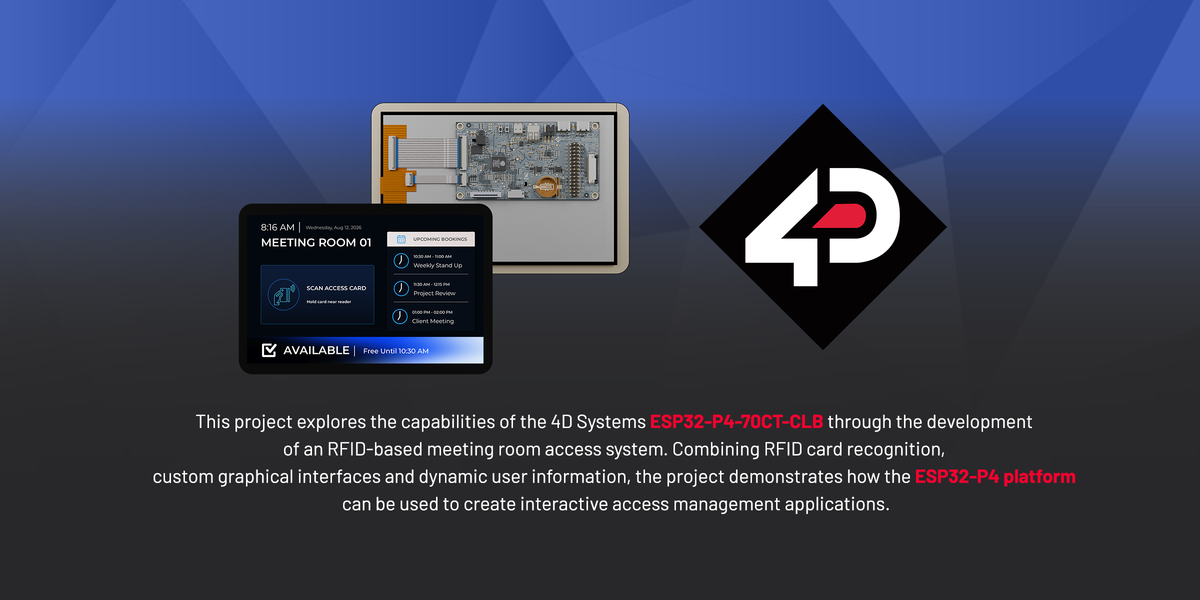
At the centre of the project is the ESP32-P4-70CT-CLB, a 7-inch capacitive touch display featuring a 1280 × 800 pixel resolution.
The display's large format provides ample space for presenting room information, user profiles and access notifications, making it particularly well-suited to applications such as meeting room management, building interfaces and access control systems.
For RFID functionality, the project uses an RFID-RC522 reader, which communicates with the ESP32-P4 through SPI.
An LM3940 voltage regulator steps the display's 5V output down to the 3.3V required by the RFID reader, allowing the external hardware to operate alongside the display.
Custom Graphical Interface
The meeting room interface was designed using Adobe Illustrator and implemented in Workshop4, creating a cohesive visual experience across different access states.

Rather than using entirely separate graphics for every user, the project combines static graphical assets with dynamically generated text. This allows multiple user profiles to share the same interface layout while displaying personalised information.
The interface includes four distinct states:
- Idle Screen: A blue standby interface displaying the room name, upcoming bookings, room availability and an RFID scanning prompt.
- Authorised Access: A green confirmation screen displaying the recognised user's name and access level.
- Guest Access: A gold interface identifying temporary guest profiles.
- Access Denied: A red notification screen displayed when an unrecognised RFID card is scanned.
Each state uses consistent typography, icons and layouts, with colour helping users immediately recognise the result of their card scan.
RFID Recognition and Access Logic
The system identifies RFID cards using their unique identifiers (UIDs), which are compared against a list of registered profiles stored in the program.
When a card is scanned, the ESP32-P4 reads its UID and determines which interface should be displayed.
Recognised staff cards display the authorised access screen with the corresponding user's information, while registered guest cards activate the dedicated guest interface. Any unrecognised card automatically triggers the access denied screen.
The project uses reusable drawing functions to populate user information dynamically, eliminating the need to create separate graphical assets for every registered card.
After displaying the result for three seconds, the system automatically returns to its idle screen, ready for the next scan.
Get Started with the Project
This project brings together the ESP32-P4's display capabilities, external RFID hardware and custom graphical assets to demonstrate a practical meeting room access interface.
Whether you're exploring RFID applications, user identification or interactive building management systems, it's a great starting point for experimenting with the ESP32-P4 platform.
The example can also be expanded with additional user profiles, access levels and functionality to suit different applications.
For more information on the ESP32-P4 display range and other development solutions, visit the 4D Systems website, or explore the 4D Systems Resource Centre and forums for additional resources and support.